
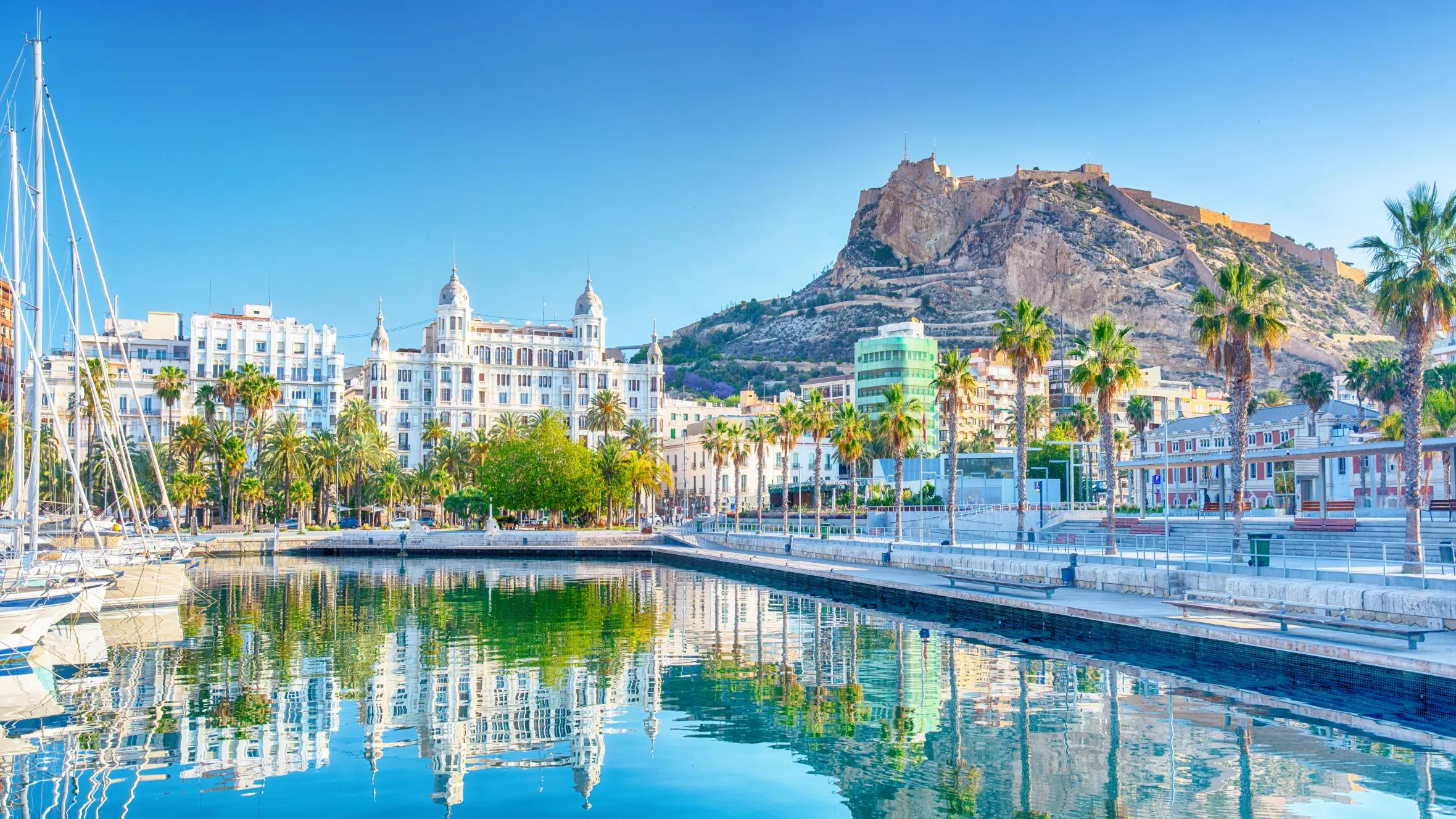
If you are wondering what to see in Alicante in 3 days, you can spend the first day exploring the historic centre and reserve the next two for some of the most interesting places in the province. Our suggested itinerary combines Alicante city, Guadalest, Altea and Villajoyosa with an afternoon by the Mediterranean.
On the first day, you will barely need the car. Park near the centre and explore the Central Market, Santa Bárbara Castle, Santa Cruz, the old town and the Explanada on foot. On day two, swap the city streets for a road trip to Guadalest and Altea. For the third day, we suggest Villajoyosa followed by an afternoon at Playa de San Juan or Cabo de las Huertas.
The result is a varied itinerary with reasonable travel times. You can visit monuments, stop for lunch and enjoy each destination without turning your holiday into an endless series of drives.
Alicante in 3 Days: Complete Itinerary
This itinerary works as a starting point. The times are recommendations to help organise your day, not the official opening hours of the attractions. Check the access conditions for each place before you leave.
Day | Route | Main Plan | Car Use |
|---|---|---|---|
Day 1 | Alicante city | Market, castle, Santa Cruz, old town, Explanada and Postiguet | Park once and continue on foot |
Day 2 | Alicante → Guadalest → Altea → Alicante | Inland province, castle, old town and viewpoints | Necessary for this route |
Day 3 | Alicante → Villajoyosa → San Juan or Cabo de las Huertas → Alicante | Historic centre, seafront promenade and coast | Recommended |
If you arrive the previous afternoon, use the time to collect the car, leave your luggage at the accommodation and find the parking facility you will use the following day. For the city centre, check our guide on where to park in Alicante before choosing a car park.
Day 1: What to See in Alicante City
9:00 – Alicante Central Market
Start at the Central Market on Avenida Alfonso X El Sabio. Visiting in the morning makes sense because the market is still busy, and you can find fruit, fish, meat, cold cuts, bread, sweets and other local products.
The building itself is also worth a look. The current market opened in the 1920s and combines an iron structure with elements of eclectic architecture. Alicante Tourism presents it as one of the city’s reference points for discovering local gastronomy. Its published opening hours are from 7:00 to 14:30 Monday to Friday and until 15:00 on Saturdays.
Allow between 45 minutes and an hour. You can have breakfast nearby or buy something for later, but avoid filling the car with products that need refrigeration if you plan to spend the whole day walking.
From here, continue towards Santa Bárbara.
10:30 – Santa Bárbara Castle
Santa Bárbara Castle occupies the top of Mount Benacantil and dominates much of Alicante’s skyline. For a first visit, allow two to three hours, especially if you want to explore the different parts of the fortress and stop at its viewpoints. Alicante’s own official three-day itinerary also allocates around two to three hours to the castle.
Do not try to drive up to the fortress and park there. Alicante Tourism states that parking inside the castle grounds is not permitted. You can walk up, use the lifts opposite Postiguet Beach or take the shuttle connecting different parts of the city with the castle.
If you want to save energy for the rest of the day, the lift is practical. If you prefer walking, keep the incline and temperature in mind. A climb that feels pleasant on a mild morning can become tiring around midday in summer.
Access hours change depending on the season. Alicante Tourism publishes longer opening periods in summer and shorter ones in winter, so check the information for your travel dates.
Once you reach the top, do not rush the visit. Explore the fortress, look at the port and city from different levels, and take a few minutes to decide which way you want to descend. The next stop is on the slopes of the same hill.
13:00 – Santa Cruz Neighbourhood
The Santa Cruz neighbourhood changes the atmosphere completely. You move from a large fortress to narrow streets, white façades, flowerpots and small squares on the slopes of Benacantil.
The neighbourhood can only be explored on foot, and its streets include some steep slopes. Alicante Tourism warns that parts of the route may be difficult for people with reduced mobility.
Allow around 45 minutes to an hour. You can visit the Santa Cruz Hermitage and the viewpoint of the same name, which overlooks the old town, the harbour and the Mediterranean.
There is no need to memorise a list of streets. Santa Cruz is best enjoyed with a short walk between the viewpoint and the lower part of the neighbourhood. If you are travelling with small children, bring water and adapt the route to the steep streets.
When you finish, you will already be close to the historic centre and can continue to the next part of the day without returning to the car.
14:00 – Old Town and Lunch
After Santa Cruz, walk through the historic centre towards the Basilica of Santa María, the Alicante Museum of Contemporary Art and the Co-Cathedral of San Nicolás. Decide how many places you want to visit inside. Entering every monument and museum can easily take the entire afternoon, while seeing some from the outside leaves enough time to sit down for lunch and reach the sea without rushing.
If you are interested in contemporary art, MACA is one of the main cultural options in this area. The municipal tourism calendar continues to list the museum among the venues with permanent and temporary exhibitions during 2026.
For a first trip, we recommend choosing one museum or indoor attraction rather than trying to visit them all. Afterwards, take time for lunch in the old town. This avoids a common problem with Alicante itineraries: adding monuments simply because they happen to be close together.
17:00 – Explanada de España and the Harbour
Continue towards the sea and reach the Explanada de España, one of Alicante’s most recognisable promenades. Palm trees and its distinctive wave-patterned pavement accompany the route running parallel to the harbour.
You do not need a strict schedule here. Allow about an hour to walk from the centre towards the Explanada, pass Casa Carbonell and reach the marina area. Alicante’s official waterfront tourist route links several of these points along the seafront. The walk connects the city centre with the harbour and Postiguet without the need for a car.
If you have spent much of the day visiting buildings, this part offers a welcome break. You can sit down for a drink or continue directly to the beach.
18:30 – Postiguet Beach
Postiguet lies next to the city centre at the foot of Mount Benacantil, which makes it an easy final stop on the first day. You do not need to spend half the day here. A swim, a walk along the shore or an hour of relaxation is enough to include some beach time without sacrificing the city sights.
If you would rather spend several hours on the sand, adjust the itinerary by reducing the time spent in the old town and coming down from Santa Bárbara earlier.
To compare Postiguet with other sandy beaches and coves in the province, see our guide to Alicante beaches and coves.
20:30 – Dinner in the Centre or Near the Harbour
Finish the first day wherever is most convenient.
If your accommodation is in the centre, head back towards the old town and have dinner there. If you prefer to stay close to the sea, look for somewhere between the Explanada and the harbour.
There is no need to move the car again just for dinner. After a full day of walking, leaving it in the same car park makes the return to your accommodation easier.
Day 2: Road Trip to Guadalest and Altea
8:30 – Departure from Alicante
On the second day, having a car is worthwhile.
The road distance from Alicante to El Castell de Guadalest is around 63 kilometres, with a driving time of approximately one hour under normal conditions.
Leave at around 8:30. This gives you enough time to arrive early, spend the morning exploring the historic centre and still have a full afternoon in Altea.
Before setting off, save your chosen Guadalest parking location in the navigation system. Bring water and comfortable shoes, as the final part of the visit is completed on foot.
If you want to compare this route with other destinations in the province, our guide to beautiful towns in Alicante covers Guadalest, Altea, Calpe, Moraira, Jávea and Dénia.
10:00 – El Castell de Guadalest
Many of Guadalest’s main attractions are concentrated around its historic centre.
Start in the village and continue towards Casa Orduña. The museum occupies a house built after the earthquake of 1644 and preserves various rooms, a library and exhibition spaces. It also provides access to San José Castle.
Allow between two and three hours for this itinerary. The aim is to visit the castle, explore the historic centre and stop at the viewpoints.
You can add other museums, but every extra visit leaves less time for Altea. If one is particularly interesting to you, visit it and adjust your departure time. You do not need to see every collection for the excursion to feel complete.
The road between Guadalest and Altea is approximately 21–22 kilometres long and includes a number of bends. Allow around half an hour for this section and avoid planning the drive too tightly.
13:00 – Lunch Before Continuing
You have two practical options. You can eat in Guadalest and drive to Altea afterwards, or leave after the visit and find a restaurant once you reach the coast. Choose depending on what time you finish exploring the castle.
If you had an early breakfast, eating before the drive prevents you from arriving in Altea hungry and in a rush. If you are not hungry yet, use the drive as a break and save more time for the second destination.
The itinerary works as long as you arrive in Altea with several hours of daylight remaining. You do not need to follow every scheduled time to the minute.
15:00 – What to See in Altea in the Afternoon
Park the car and walk uphill towards the old town.
The route can begin at the old entrances to the town and continue past white houses, cobbled streets and viewpoints towards Plaza de la Iglesia. Here you will find Nuestra Señora del Consuelo, known for its blue-and-white domes. The regional tourism website specifically recommends exploring this historic area and its old gateways before reaching the church.
Allow around two or three hours. Explore the streets of the old town, visit one of the viewpoints and then walk down towards the seafront if you still have time. Altea has enough to fill an entire day. On this trip, however, it provides a good contrast with Guadalest: first you see a small fortified inland settlement, then a town open to the Mediterranean.
Do not add Calpe simply because it is nearby. Arriving, parking, taking one photograph and getting straight back on the road adds little to a day that already includes two destinations.
19:00 – Return to Alicante
The distance from Altea to Alicante is around 59 kilometres, and the routes checked take approximately 50 minutes by car.
Across the three main sections, the day totals approximately 143 kilometres: around 63 km from Alicante to Guadalest, approximately 21 km from Guadalest to Altea and around 59 km for the return journey. Small differences depend on your chosen parking locations and route.
Return to Alicante, park the car and leave the rest of the evening free for dinner. After several hours of driving and walking, adding a third sightseeing stop creates more fatigue than value.
Day 3: Villajoyosa and the Alicante Coast
9:00 – Alicante → Villajoyosa
For the final day, we suggest combining a historic seaside centre with an afternoon at the beach. Villajoyosa, or La Vila Joiosa, is approximately 35 kilometres by road from Alicante according to the routes consulted.
Leave at around nine and drive directly to your chosen parking area near the centre. Once there, leave the car and complete the first part of the visit on foot.
10:00 – What to See in Villajoyosa
Start with the historic centre.
Colourful façades are one of Villajoyosa’s defining features. The centre preserves traditional houses, Renaissance walls and the Fortress Church of Nuestra Señora de la Asunción. The historic complex is protected as a Bien de Interés Cultural, or Asset of Cultural Interest.
One of the best places to see the houses built above the former city wall is around the Amadorio riverbed. Villajoyosa’s municipal tourism website also recommends this area as a viewpoint for the stone walls and painted façades.
Continue towards Passeig Sant Pere, opposite Playa Centro. This section links the old town with the municipality’s maritime past and allows you to continue walking beside the Mediterranean.
Allow two or three hours for the complete route. If you want to include a chocolate-related visit, extend the morning and reduce the amount of time spent at the beach afterwards.
13:00 – Lunch by the Sea
After the walk, you can have lunch near the coast. There is no need to look for another destination before eating. Villajoyosa has Playa Centro directly beside the urban centre, surrounded by a promenade, restaurants and shops. At this point, decide what you want to do during the afternoon.
If you have had enough driving and want to remain by the sea, you can stay in Villajoyosa. If you would rather finish your holiday closer to Alicante, drive towards Playa de San Juan or Cabo de las Huertas.
15:30 – Option 1: Playa de San Juan
Playa de San Juan works well for an afternoon dedicated to swimming and relaxing. From Villajoyosa to the Playa de San Juan area, the road distance is approximately 27–29 kilometres depending on your exact starting point and destination.
Once you arrive, park and avoid moving the car again. Choose the most convenient beach access and spend the afternoon relaxing.
From Playa de San Juan to central Alicante, there are approximately 8 kilometres left, making the final return journey short compared with the drives on day two.
This option is particularly suitable if you are travelling with children, want a sandy beach and prefer spending several hours in one place.
15:30 – Option 2: Cabo de las Huertas
Choose Cabo de las Huertas if you prefer a rocky coastline and a short walk instead of an entire afternoon on the sand. You can visit one of its coves, enjoy the coastal scenery and return to Alicante afterwards.
Do not try to cover the entire area in just a few hours. Choose one access point and check the terrain before heading down with bags or beach equipment.
If the sea is rough or you do not feel like swimming, treat the cape as a walking destination and return to the city afterwards.
19:00 – Return to Alicante
The third day should finish early enough to give you time to shower, rest and prepare for your departure the following day.
If you are returning the car that evening, check the agreed return time before staying too long at the beach. If you are returning it the next day, check the fuel or battery level and organise your luggage.
Map of the 3-Day Alicante Route
To prepare the itinerary, divide the map into three separate sections.
Day 1 includes the Central Market, Santa Bárbara Castle, Santa Cruz, the old town, the Explanada and Postiguet. Park once and complete the itinerary on foot.
Day 2 follows Alicante → Guadalest → Altea → Alicante. Enter the parking facilities as destinations in your navigation system instead of directing the car into the narrow central streets of the historic areas.
Day 3 follows Alicante → Villajoyosa → Playa de San Juan or Cabo de las Huertas → Alicante.
Save each day separately. A single map containing every stop could incorrectly suggest that you need to visit all of them consecutively.
How Many Kilometres Will You Drive in 3 Days?
The total mileage depends on the location of your accommodation and the streets you drive through in Alicante, but the two excursions make it possible to estimate the distance in advance.
Day | Main Route | Approximate Mileage |
|---|---|---|
Day 1 | Alicante city | Depends on accommodation and parking |
Day 2 | Alicante → Guadalest → Altea → Alicante | ≈ 143 km |
Day 3 | Alicante → Villajoyosa → San Juan → Alicante | ≈ 70 km |
Total excursions | Days 2 and 3 | ≈ 213 km |
The third day includes approximately 35 km to Villajoyosa, another 27–29 km to San Juan and around 8 km for the return to Alicante.
Add journeys to and from your accommodation, restaurants, car parks and any other detours. A total allowance of 230–250 kilometres for the full itinerary is more useful than simply adding the distances between town centres.
This calculation also helps when choosing a vehicle. Before renting, check the mileage included in the agreement and the cost of any excess mileage. Our guide to the requirements for renting a car in Spain also explains what to check regarding the deposit, documents and driver conditions.
Where to Park During This Route
In Alicante city, avoid driving from one attraction to another. Find a car park near the centre, leave the vehicle there and complete the first day on foot. Santa Cruz is pedestrian-only, and parking inside the grounds of Santa Bárbara Castle is not permitted.
In Guadalest, Altea and Villajoyosa, save the location of a car park before you leave. Once you arrive, complete the rest of the route on foot. This prevents you from entering narrow streets while searching for a space.
For Playa de San Juan or Cabo de las Huertas, check the parking conditions in the area where you intend to leave the car. During the busiest months, having an alternative parking plan can prevent you from spending part of the afternoon driving around looking for a space.
Our Alicante parking guide contains more detailed information about ORA parking regulations, blue zones, city-centre car parks, the harbour and the railway station.
How to Adapt the Itinerary to Your Trip
Alicante in 3 Days with Children
Reduce the number of indoor visits and allow more breaks. On the first day, you can combine the castle with the old town and finish earlier at Postiguet. To reach Santa Bárbara, the lift or shuttle saves you a long uphill walk. The Santa Cruz neighbourhood has narrow, steep streets, so adapt this part if you are travelling with a pushchair.
On the second day, keep Guadalest and Altea but avoid trying to visit too many museums. A castle visit and a walk through each town leave enough time for eating and resting.
On the third day, Playa de San Juan will usually work better than a long route across rocky terrain. You could even skip Villajoyosa if the family would prefer to spend the entire day at the beach.
Alicante for Couples
You can keep the full itinerary and extend the parts that are especially enjoyable later in the day.
In Altea, stay until late afternoon. In Alicante, make time for a walk along the Explanada after dinner. On the third day, you can swap Playa de San Juan for Cabo de las Huertas if you prefer walking and exploring a cove.
For this combination of city and coast, a convertible can become part of the experience if the luggage capacity and rental terms suit your plans. Check the available boot space before booking, particularly if you are travelling with several suitcases.
What to Do in Alicante if It Rains
Change the order of the days before cancelling activities. Save the day with the best weather forecast for Guadalest and Altea. On a rainy day, you can spend more time at MACA, MARQ, the Central Market and other cultural attractions in Alicante. The 2026 tourism calendar continues to include active exhibitions at both MACA and MARQ.
Do not drive to a viewpoint simply because it appears in the itinerary. If the weather prevents you from enjoying the views, move the excursion to another day.
Is Tabarca Worth Visiting if You Only Have 3 Days?
Yes, if a boat trip is an important part of your plans. Alicante Tourism’s official three-day itinerary allocates around six hours to Tabarca, including transport.
This means you should treat it as a full-day or main activity rather than a quick stop between Villajoyosa and the beach.
To include Tabarca in our itinerary, replace day three. Keep the first day in Alicante and the second in Guadalest and Altea. Spend the third day on the boat journey, the island and the return to the city.
You do not need a car for this part of the trip. Alicante Tourism provides information about boat connections from Alicante to Tabarca.
If it is your first visit and you want to experience both the city and the province by road, I would keep Villajoyosa. If swimming, coves and a day at sea are your priorities, I would choose Tabarca.
What to See in Alicante if You Have More or Less Time
Alicante in 1 Day
With just one day, focus on the city. Start at Santa Bárbara, walk down towards Santa Cruz and the old town, and finish at the Explanada. If you visit the Central Market, go there early in the morning because it closes in the afternoon. Postiguet can be the final stop if you still have time.
Alicante in 2 Days
Spend the first day in the city centre and use the second for Guadalest and Altea. This gives you two very different perspectives on the province without spending most of the trip behind the wheel.
Alicante in 4 or 5 Days
With a fourth day, you can continue towards Calpe and Moraira. With a fifth, Jávea or Dénia deserves a separate day. Avoid turning every town into a two-hour stop. Once you have four or more days, it is more enjoyable to dedicate larger blocks of time to different areas of the Costa Blanca.
Our route through the towns of Alicante allows you to compare these destinations before choosing.
Frequently Asked Questions About What to See in Alicante in 3 Days
Are 3 Days Enough to Visit Alicante?
Yes. Three days are enough to see the main attractions in the city centre and leave time for one or two excursions. If you also want to include museums, hiking, several beaches and towns in the north of the province, you will need more time.
Do You Need a Car to Visit Alicante?
Not for the city centre. You can explore most of the first day on foot and use the lift or public transport to reach Santa Bárbara Castle. A car is much more useful on the second day when combining Guadalest and Altea, and it also makes the third-day route through Villajoyosa and the coast easier.
What Should I Not Miss in Alicante?
For a first visit, we recommend Santa Bárbara Castle, Santa Cruz, the old town, the Explanada and the waterfront. Then add one destination elsewhere in the province. Guadalest and Altea form a convenient combination for a one-day road trip.
Which Towns Should You Visit Near Alicante?
Guadalest and Altea work well together because they are separated by approximately 21 kilometres. If you have more time, consider Calpe, Moraira, Jávea and Dénia. Each deserves more than just a short stop for photographs.
Which Beach Should I Visit if I Only Have Three Days?
Choose Postiguet if you only want to spend a short time by the sea during your visit to the city centre. For an afternoon dedicated to the beach, Playa de San Juan is more practical within the itinerary we suggest. Cabo de las Huertas is better if you are looking for small coves and a rocky coastline.
Where Should I Park to Visit Alicante City Centre?
Choose a car park based on the part of the city where you plan to begin and leave the vehicle there while you explore on foot. Do not try to park in Santa Cruz or drive into the grounds of Santa Bárbara Castle looking for a space: Santa Cruz is pedestrian-only and visitor parking is not permitted at the castle.
Explore Alicante and Its Surroundings with ClanRent
When planning a car rental in Alicante, first calculate how many passengers will be travelling, how much luggage you will have and approximately how many kilometres you expect to drive.
In this itinerary, the two excursion days alone add up to just over 200 kilometres before local journeys are included. Check the mileage included with the vehicle and the rental conditions applicable to your dates.
If you want to enjoy the roads of the Costa Blanca with the roof down, you can also explore ClanRent’s convertible cars. Choose your model based on space, comfort and rental conditions, and save your routes to Guadalest, Altea and Villajoyosa before setting off.